
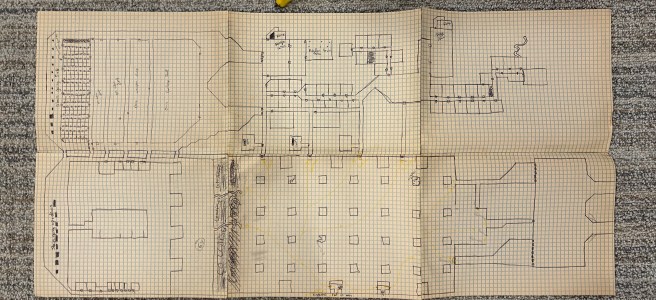
Last week I shared about the joy I get from reading my Dad’s old gaming characters and notes. At the end of the post I talked about how I am incorporating his gaming notes, and my piles of gaming notes from the last two decades, into a setting going forward.
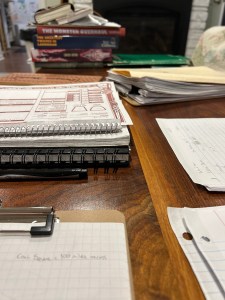
I wanted to share more about the worldbuilding of this setting today!
Psst – it turns out this post is my 100th blog post! Come celebrate with me by joining my newsletter, where I share free games, gaming thoughts, deals, and other fun tabletop gaming news!
What is the Fourth Age
I’ve always wanted to gamify, in some way, my previous gaming characters, adventures, and notes. It’s easy and fun to do callbacks when running a game, but I wanted something a bit more substantial – something more concrete.
I first had the idea of a persistent fantasy world about 7 years ago (according to my documents on Google Drive). There was a problem though – I didn’t know how to start. I gave myself questions that were too big to answer at the time, and I never followed up on the idea.
Late last year, I finally found answers to these big questions. I had decades of gaming notes, characters, and adventures just kind of lying around (including gaming notes my Dad used). I could use these notes to populate the history of the world!
The plan was simple – each era of gaming would represent an Age of History in my setting.
The First Age
The notes my Dad used would form the First Age of the setting. Since I don’t have much from his gaming days, these notes would form a basis of legends and myths. Characters like Saphron and Mug would be spoken about much the same way Achilles and Beowulf are today.
Direct evidence from this age will be rare. But, if found, it will be mighty and powerful.

The Second Age
After Dungeons and Dragons was introduced to me, I played a whole lot with my friends in Middle School and High School. We built some incredible maps, and created an epic story where the big bad evil guy, Stark, was trying to take over the known world.
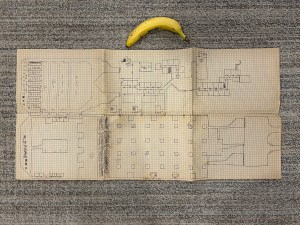
Of course it was extremely cliche, with Lord of the Rings being a huge template for our story. But I think it forms a very strong basis for historical conflict in the setting.
Interestingly enough, the bad guys won at the end of the second age. This leads to…
The Lost Age
After evil took over, the Second Age ended and the Lost Age began.
This actually represents the time in my life I took a break from role playing games to focus on finishing high school and going to college. It works in the setting too, because my friends and I never resolved this time period – we stopped playing soon after the bad guys won.
So there’s a Lost Age, where evil reigned, and not much history exists from this age.
The Third Age
The Third Age begins when I picked back up role playing games, once I finished college. It represents about the last 10 years of gaming for me, up until now.
This time period is one of RPG exploration. I played many different games, across many different genres. Anything even remotely close to the fantasy genre is included in the setting for this age, including my Dungeon Crawl Classics games, solo projects, and of course, Dungeons and Dragons campaigns.
I still haven’t figured out how or why this age is ending – maybe the last two sessions of my current high level Spelljammer game will determine this.
The Fourth Age
I’ve grown and improved quite a bit as a game master over the last 10 years. I feel like I’ve recently leveled up in how I am able to prepare for and run games, so it feels natural to me to begin a new age.
So, once my Spelljammer campaign is complete in March, all games I run going forward will take place in the Fourth Age of my setting.
Worldbuilding Goals
Last night I sat down and started outlining what this setting means for me, and the games I’ll be running in the future. It was kind of a brainstorming session, but one with a purpose. The big question I was trying to answer was:
How can I make playing in a setting where history is determined by previous games fun?
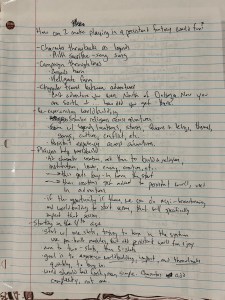
The joy and fun for me is clear – I love going through old gaming stuff. Last night I just kind of sat for an hour, reading my old gaming stuff. I even discovered an old, unfinished solo campaign I started about exploring the Temple of Elemental Evil!
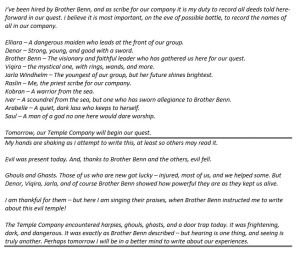
The bigger question is about my players – how can this be fun for them? So I made a list.
Character Throwbacks as Legends
Previous characters, especially fun ones, will be referenced in games going forward. So that funny story about a character dying because he failed his strength roll to pick up a manhole cover – there’s a song about that now.
Campaign Throughlines
After finishing The Lost Temple, one of the characters kept the Horn of Zargon. Where is it now? Also, what happened to the gate to hell on that one farm from our campaign four years ago? These can become plot points for future adventures in the Fourth Age.
Campaigns vs Adventures
I have spent the last few years working really hard on creating an open table concept that works for long campaigns. I was successful, but am getting tired of it. I want to focus on shorter adventures (1-3 sessions) that have a clear start and finish, but whose characters can persist in the world.
It will feel like a campaign if a player is able to make several short adventures in a row. But if they can’t there’s not the awkward feeling about coming back to a campaign after missing five or six sessions.
Re-Experiencing Worldbuilding
To help with the above, I want there to be persistent themes in the world. For example, if two adventures occur in two different places, the PCs may encounter a priest of the same religion in both adventures. That will help tie the world together as it builds familiarity across adventures and regions.
Players Help with Worldbuilding
This is probably the most important aspect of making this idea fun for my players. I think it’s important that the players feel the impact of their game right away. I believe this will help the players buy into the world more often, and it will help create a living world, not just one I am creating on my own.
This would likely occur as a mini-worldbuilding session prior to the start of an adventure. I can see it being quite fun to, without context, give my players mad-lib style questions about the horrible powers a magical creature has. Then, when I introduce the adventure, the players realize they’ll need to hunt this creature down and kill it – the same one they just armed with poison fangs and the ability to turn invisible.
To go a bit further, I also want the players to have the ability to impact the world from the start. I can’t remember where I saw this metaphor earlier, but I want the world to be more like a playground, and less like a museum.
Wonder
My biggest joy in gaming is one I get from exploration and discovery. I love recreating this feeling in games. Locations in my world should evoke the feeling of wonder. But this isn’t always easy to do.
I think that discovery and exploration lead to wonder, or stem from it.
Discovery and exploration can only come from learning the answers to secrets, and like Monster of the Week tries to do, finding more about the world in each session. This is something I’ll keep in mind when selecting adventures to run.
Artifacts from Old Campaigns
If possible, I’d love to hand out artifacts from old campaigns. This would be a fun throwback for the players who participated in those campaigns years ago.
Going Forward with the Fourth Age
At this point, I think I have a good plan for the Fourth Age of this setting. I’m motivated by it, and I think that the list above includes some really good ideas about how my players can get more fun from this setting as well.
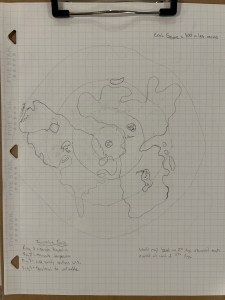
I have a map sketched (based on my gaming notes from 23 years ago). This will help me place the adventures we run somewhere on the map. I have piles of history for the setting, which will help me add flavor and depth to any adventure I run. And my players are going to help with worldbuilding.
I’m not really sure what my next steps will be though.
I think at this point, I’ll just let the setting sit. It’ll percolate or ferment (I’m not sure which is more appropriate here), and when I’m ready to run the first one-shot in the Fourth Age, the setting will be ready for me.
Share Your Support
You can share your support of me and Paper Dice Games in one of the following ways!
- Join the PDG Email List
- Subscribe to the Paper Dice Games Youtube Channel
- Follow me on itch.io
- Follow me on DriveThruRPG
- Dwarf Mine Subreddit
Thank you for being a fan of games!
 Paper Dice Games
One thought on “Worldbuilding for the Fourth Age”